05 Electrostatic Shield and Method of Images
Electrostatic Sheild Effect
There’s no electrostatic field inside conductors and conductive cavity, as long as there’s no charge inside.
A Näive Comment
If any, the carriers in the conductor will be forced to move until there’s no electric field.
Strict yet Simple Proof
Consider the Poisson (Laplace) equation for electric potential, inside the cavity:
\nabla^2 \phi = -\frac{\rho}{\epsilon_0}=0
For the boundary condition on the surface S:
\phi\big|_S = \phi_0
Apparently there’s a trivial solution:
\phi(\bm{r}) \equiv \phi_0
Also, according to the Uniqueness Theorem of Electrostatic Fields, because we already fully know the potential distribution on the boundary, the trivial solution above is the only possible solution; thus we can directly say that
\Phi(\bm{r}) \equiv \phi_0
inside the cavity.
Method of Images
Classic Problem 1: Infinite Plate
Consider a point charge q, r away from an infinitely large conductive plate. We may as well assume that the plate is grounded. Then, the electric field distribution on the point charge side is equivalent to the distribution under 2 oppositely charged point charges, 2r away from each other, where the plate is on the equi-potential surface S\big|_{\Phi=0}.
We may also consider another problem, where the plate is kept at \phi_0 \neq 0; however, this problem can be ill-defined unless we let \Phi_\infty = \phi_0, which will in turn make the problem meaningless, as we can simply add \phi_0 uniformly.
Classic Problem 2: Conductive Sphere
Consider a conductive sphere with the radius of R; a point charge q is located a away from the center of the sphere.
Outside: a>R
This model let us remind something called Apollonius circles, where:
Choose 2 arbitrary different points A and B on a plane; the point set \{ P | \frac{|PA|}{|PB|}=k, k \neq 1 \} is a circle (2D case; it turns into a sphere in 3D from rotational symmetry).
This inspires us to consider that we can construct a virtual point charge q' inside the sphere, so that the equi-potential surface S\big|_{\Phi=0} (outside the sphere; apparently there’s no real electric field inside the sphere) is the Apollonius circle, where k=-q'/q.
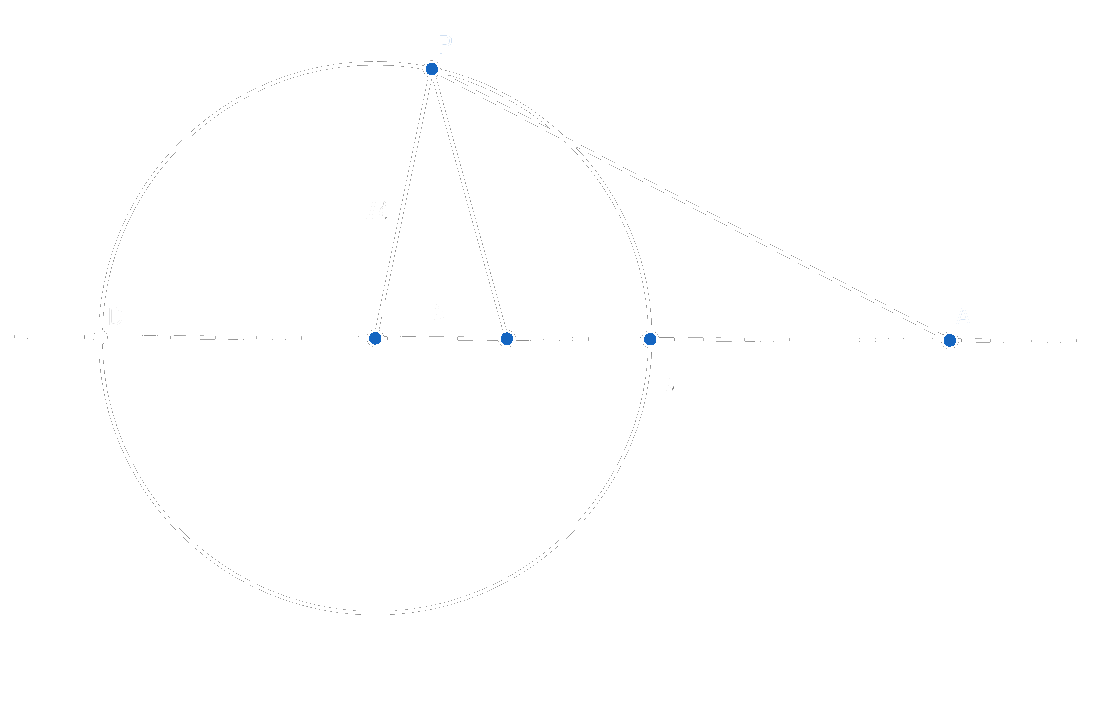
As is shown in Figure 1 ,
q|PB| = -q'|PA|
Consider C and D:
\begin{cases} q(R-b) = -q'(a-R) \\ q(R+b) = -q'(a+R) \end{cases}
from which we get:
\begin{cases} \begin{aligned} b &= R^2/a \\ q'&= -qR/a \end{aligned} \end{cases} \tag{1}
Inside: a<R
Same as Equation 1 ; however, this time, there’s no electric field outside.
Adding Extra Potential \phi_0 to the Surface
According to the principle of superposition, we can simply add a virtual point charge q_0 after we have done all these above, so that:
\frac{q_0}{4\pi \epsilon_0 R} = \phi_0
In reality, these charges are distributed uniformly outside/inside the sphere.
Special Case: Simply don’t ground the sphere
This means the net charge on the sphere is 0; hence q_0 = -q'.
Surface Charge Density \sigma
According to the boundary conditions of electrostatics,
\sigma = \epsilon_0 E_{\perp}
Another Problem: Conductive sphere in uniform field
Consider a conductive sphere put in a originally uniform electric field \bm{E_0} = E_0 \hat{x}. Inside the sphere, E_{in} = 0; this reminds us of a model, where we manually remove a small sphere inside a large sphere, where charges inside are uniformly-distributed. This could be used as our image model.
Image-model: “Negative superposition of 2 spheres”
Consider a large sphere, in which charges are distributed uniformly with charge density \rho. Then, we manually remove a small sphere, where its center is located a away from the center of the large sphere.
According to the principle of superposition, we can consider it as a superposition of the full sphere and a small sphere with the charge density of -\rho. Then, the electric field inside the cavity:
\bm{E} = \frac{\rho}{3\epsilon_0}(\bm{r}-\bm{r'}) = \frac{\rho}{3\epsilon_0}\bm{a} \tag{2}
where \bm{r} and \bm{r'} are respectively the relative position from the center of the large sphere and the small sphere.
This result shows that the electric field distribution is uniform. Also, the small sphere doesn’t neccessarily need to be fully inside the large sphere; we can also consider the intersection between the 2 spheres.
Image Setup
According to Equation 2 , we can construct 2 very near (d \rightarrow 0) spheres with opposite charge density (\rho), so that
\frac{\rho}{3\epsilon_0}d = E_0
which cancels out the electric field inside the sphere. This, from outside, is equivalent to a pair of electric dipole, located in the center of the sphere, with
\bm{p} = q\bm{d} = -4\pi R^3 \epsilon_0 \bm{E_0}
From the result of the dipole expansion,
\Phi_{\text{im}} = \frac{E_0 R^3 \cos \theta}{r^2}
Then, after superposition, we can get the full distribution of potential and field.